
Your Health Life Partner
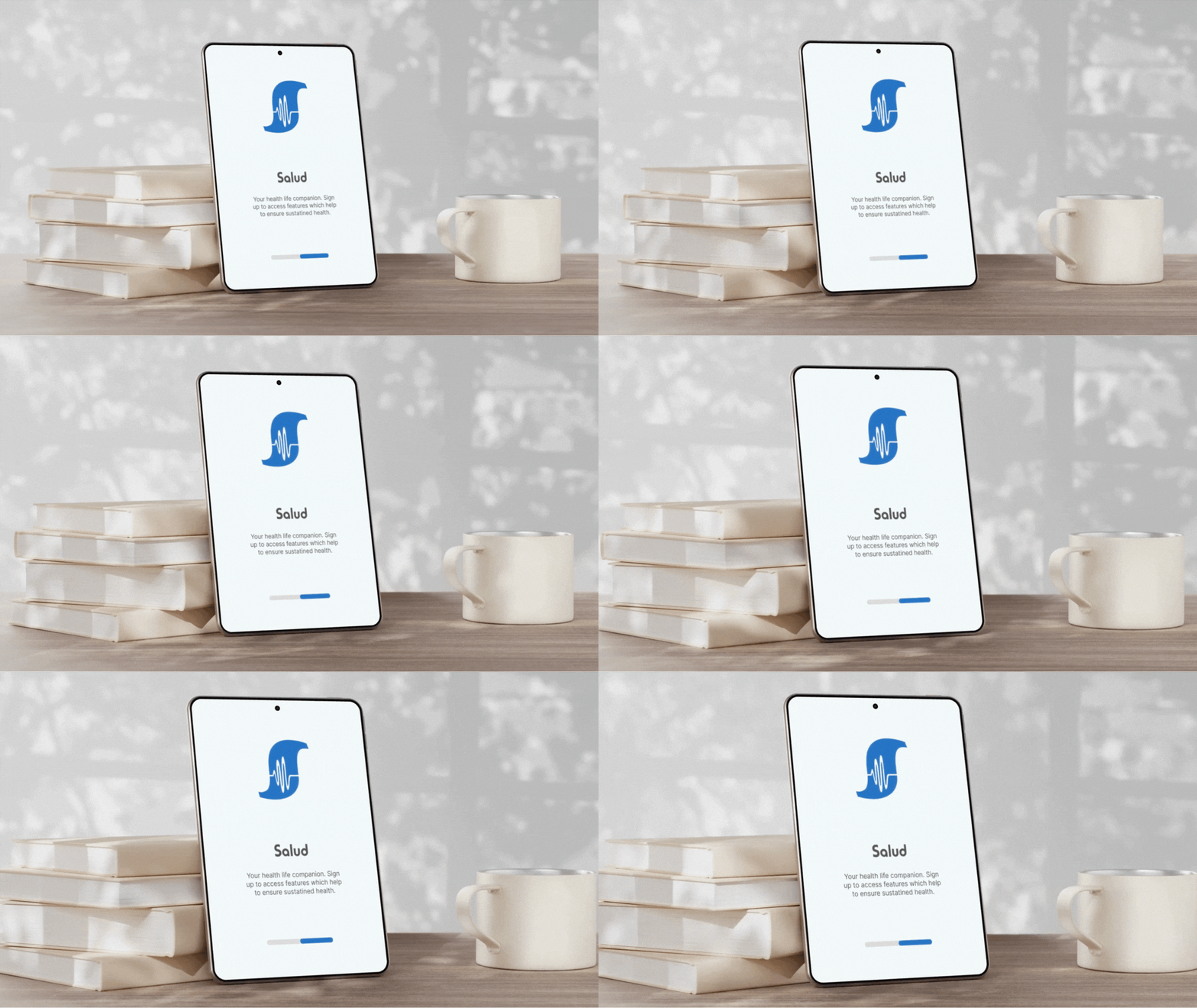
Salud is a cutting-edge medical app designed to be your trusted health life partner. With Salud, users can seamlessly store and manage their vital medical data, ensuring easy access and keeping their medical history up-to-date.
The Challenge:
In Nigeria, staying healthy is often a gamble—one where the odds are stacked against the individual. At the core of the crisis lies an invisible but devastating problem: a complete lack of centralized medical records. Most Nigerians have no digital trail of their prescriptions, past diagnoses, vaccination history, or doctor visits. Every consultation becomes a fragmented story, told from memory, vulnerable to misdiagnosis and mistreatment.
This disconnection goes beyond inconvenience—it’s dangerous. Patients can’t track their medications, remember the right dosage, or access their health history when it matters most. There’s no continuity, no secure system, no way to hand off care between doctors or clinics seamlessly. In emergencies, critical information is lost. In routine care, the absence of structure leads to repeated tests, missed red flags, and avoidable complications.
The second layer of the crisis is financial. Healthcare remains largely out-of-pocket, with health insurance covering only a tiny fraction of the population. While healthcare grants and subsidies exist, the systems that deliver them are confusing, inconsistent, or simply not trusted. People are drowning in medical costs—not because there’s no help, but because the help isn’t clear or accessible.
Lastly, the problem deepens in silence. Awareness of these grants and national healthcare initiatives is minimal. The average citizen has no idea they exist, let alone how to apply. Despite Nigeria’s growing digital infrastructure—with millions of citizens using smartphones and stable internet daily—there’s no mainstream platform to bridge this gap between connectivity and care.
This challenge is rooted in extensive research across healthcare data systems, national policy analysis, poverty impact studies, and digital access trends. Sources include data from the National Health Insurance Scheme (NHIS), Statista smartphone and internet usage reports, Chukwuma and World Bank healthcare funding publications, and audits of healthcare expenditure and donor fund utilization.

The Approach:
I wanted the health app to feel like a breath of fresh air—a space where navigating your medical history, prescriptions, or consultations didn’t feel clinical or overwhelming, but human, intuitive, and clear.
The foundation of the app’s design came from the Salud logo itself. At its heart lies a flowing ECG/EKG waveform—a squiggly line made of large, round curves. I used this motif as the spine of the interface, shaping containers, section breaks, and transitions with its organic softness. It provided a visual rhythm, like a steady heartbeat running subtly beneath every screen.
I deliberately moved away from the outdated visual language of Nigerian health systems—the cold greens, basic blacks, and Times New Roman that often signal frustration, broken links, and missing functionality. I wanted to signal trust through modern, clean design. Using bold flat colors with strong contrast, plenty of white space, and typography that breathes.
For titles, I chose Horatio D Light to give a graceful, elegant presence. For body copy, I used Inter: a highly legible, modern typeface that reads effortlessly across devices.
I designed the experience to ease users in and out of features seamlessly, creating a flow that feels less like using a tool and more like participating in a system that understands you. Every scroll, click, and interaction is meant to build trust, reduce friction, and center the user in their own health story.
Salud’s iconography follows a simple system of bold, filled shapes designed to feel intuitive and convey a calm, intelligent, and deeply human experience.


fresh air
for Nigerian healthcare. Designing an experience that feels as calm as it is powerful
A breath of
The Solution:
Salud was created to fill a critical void left by Nigeria’s fractured and disconnected healthcare data systems.
In a country where most citizens have no centralized medical records—where prescriptions go untracked, appointments are missed, and personal health histories are scattered or undocumented—Salud offers structure, clarity, and continuity. This lack of unified data leaves millions vulnerable to misdiagnoses, redundant tests, and fragmented care.
Salud steps in as a personal, portable health record—designed for the individual, yet powerful enough to bridge national healthcare gaps.
Users can:
-
Log consultations, diagnoses, and prescriptions with time-stamped entries
-
Track medications and appointments, with notifications and refill reminders
-
Record pharmacy visits and self-reported symptoms, capturing the full spectrum of personal health history
-
Export and share health data securely with clinics or caregivers
-
Access educational content on how to reduce healthcare costs through available grants and funding
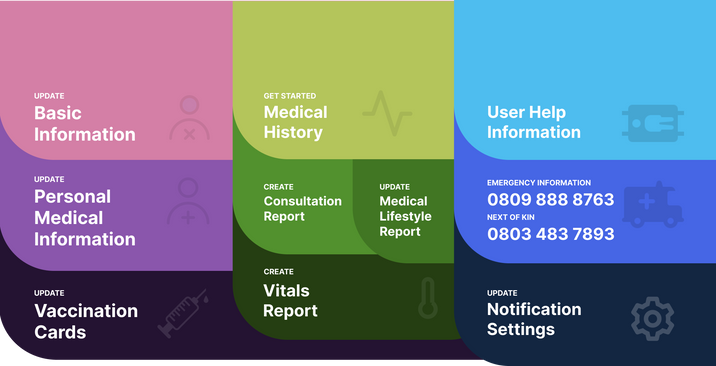
Beyond health tracking, Salud also begins to address Nigeria’s underdeveloped health insurance ecosystem, a key secondary feature on its development roadmap in a stylish and approachable way. As the app evolves, its soft edges and flowing visual curves will support access to affordable healthcare through social health insurance schemes, as well as federal, state, and donor-funded healthcare grants. Users will be matched with relevant opportunities based on their location, income, and needs, opening doors to free or subsidized care delivered through intuitive, contrasting blocks of the mobile app interface.
Where the national system falls short, Salud steps in: a modern, empowering tool that gives users greater control, visibility, and access to better healthcare.


Your health life companion

The Impact:
The MVP version of Salud was downloaded over 100 times across iOS and Android platforms, with the largest user concentration coming from urban centers in Lagos and Abuja.
While the download numbers may seem modest, they were achieved without any paid advertising or active PR efforts—a clear testament to the unmet demand among Nigerians for a tool that puts their health information, access, and agency in one place.
Salud’s early traction signals a larger shift.
It’s not just about downloads—it’s about a movement. A movement where West Africans are empowered to take ownership of their medical history, often for the very first time. A platform where disconnected communities are being linked to care, coverage, and clarity.
And for every symptom logged, every record retrieved, and every grant received—it tells a simple, powerful story:
Your health matters. And now, it’s in your hands.
